
A better glance at the work
Closer side consoles and clear drone readouts are making the mining cockpit easier to understand.
Locally validated at 4819300; runtime source is unpublished and this checkpoint is separate from the reactor prototype.
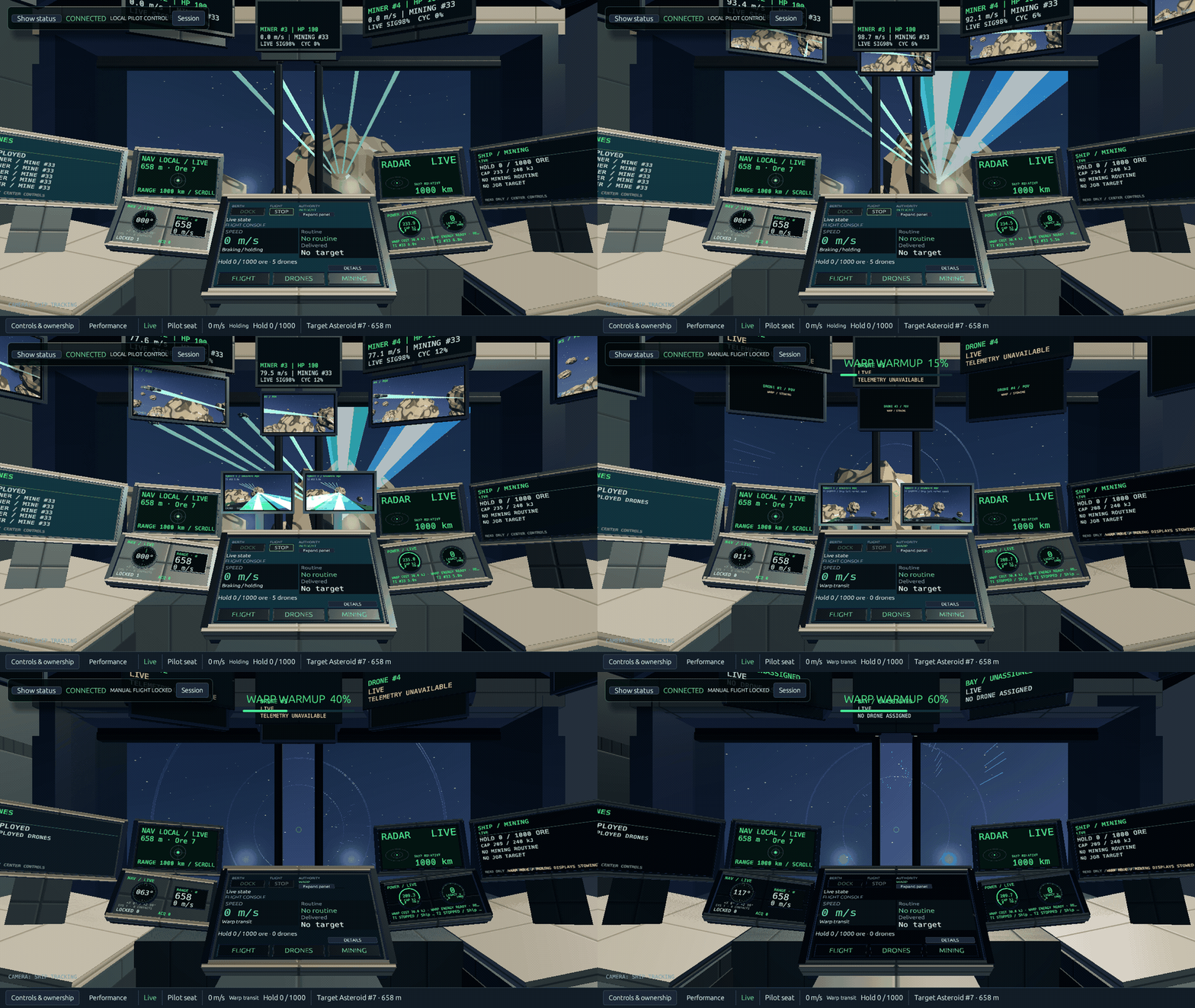
Play GIF Pause GIF · show still Capture details · motion paused Monitor deployment / warp stow
Actual captured frames with edited playback timing and endpoint holds. Edited playback is not a frame-rate benchmark. Reduced-motion settings or “Pause animations” show a still. Open original GIF. Open still.
Start with the captain's view
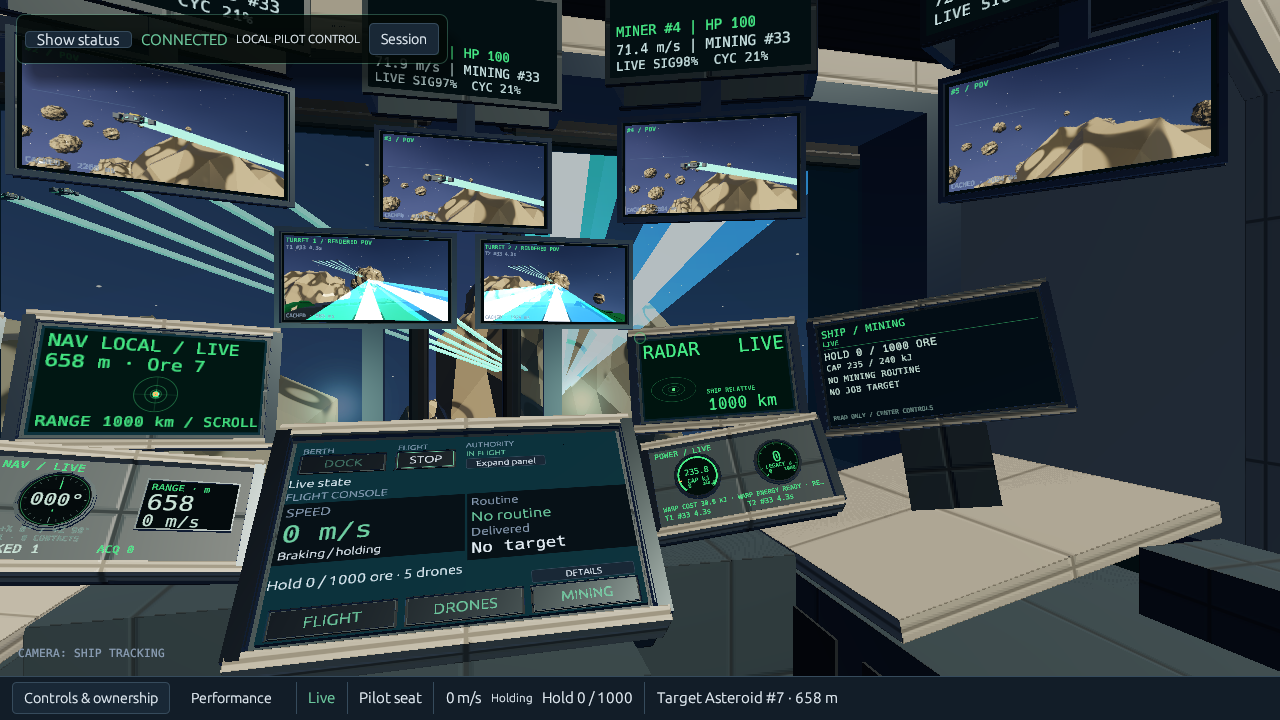
Once the seven camera monitors could move, their placement became the next question. A working screen still has to be readable from the seat. The latest local pass brings the full-size side displays into the empty side-console space, where a 15-degree glance gives a useful view. The deployed turret screens also clear the permanent navigation display. These are small spatial changes with a direct effect on how the cockpit can be read.
The arrangement still asks the captain to look around. All five drone views and their metric bands are not visible comfortably in one forward stare. That is worth keeping in the record: the aim is a usable cockpit with a clear hierarchy, rather than squeezing every instrument into the center of the windscreen.
Give each view a real identity
Five strips on the cassette fronts connect the pictures to the drones doing the work. They show actual drone identity, health, speed derived from velocity, operating mode, signal and cycle data. Keeping a stable identity beside a camera matters when several drones are active at once. Storage is not modeled for these drones, so the display does not invent a capacity number to fill the space.
Testing also exposed a camera-feed visibility problem when looking right or up. The local correction handles that gate separately from the older four-view navigation display. A feed needs to be visible for the right reason, and stale or disconnected data needs to stay recognizable. More numbers on a panel cannot compensate for a view that disappears at the wrong angle.
What this checkpoint tells us
Local validation recorded 66 protocol, 91 server and 14 verifier tests passing. The client recorded 495 passes, with 11 inherited failures and 30 ignored tests. Actual engine captures support the placement and behavior shown here; sustained performance on representative desktop hardware remains unverified.
At this checkpoint, manual monitor stow without stopping the equipment and integration with the separate reactor prototype remained further work. The animation uses actual captured samples with edited timing and endpoint holds. It shows the sequence clearly, but its playback speed is not a frame-rate measurement.