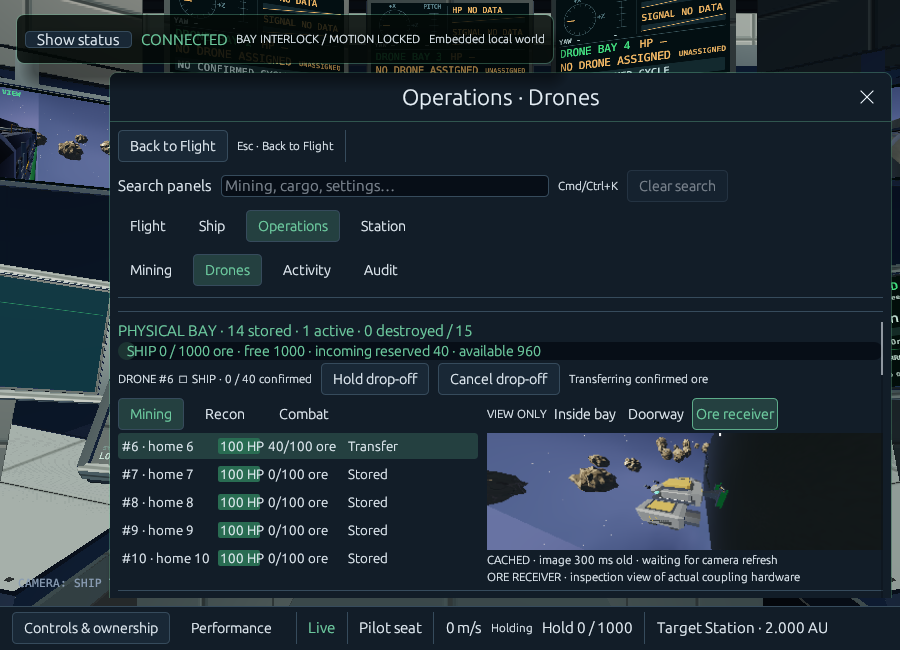
From the drone bay to the cargo hold
Deploy a mining class, bring ore back without parking the drone, then recall the fleet through a shared physical bay. This pass connects the machinery to the cargo ledger and the controls.
Source checkpoint e9ef19e is locally validated and unpublished. The captures document earlier, identified development revisions; this is not a release or an installation on a player’s machine.
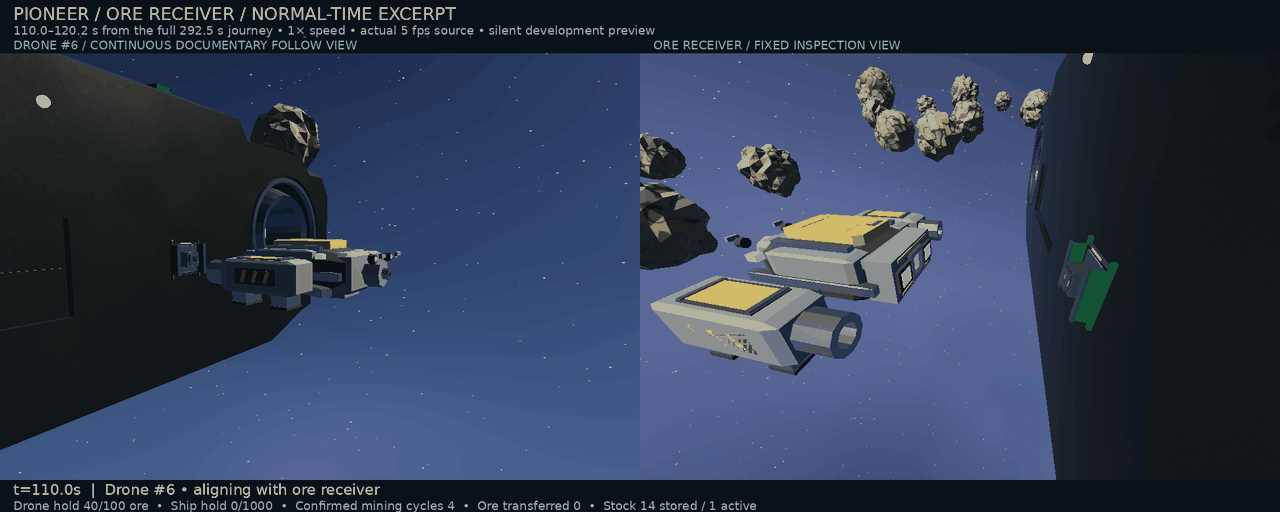
Play GIF Pause GIF · show still Capture details · motion paused Ore receiver · normal-speed excerpt
10.2 seconds from 1:50–2:00.2 of the recorded journey, at normal speed. The loop restarts; it is not the full journey or a frame-rate benchmark. Edited playback is not a frame-rate benchmark. Reduced-motion settings or “Pause animations” show a still. Open original GIF. Open still.
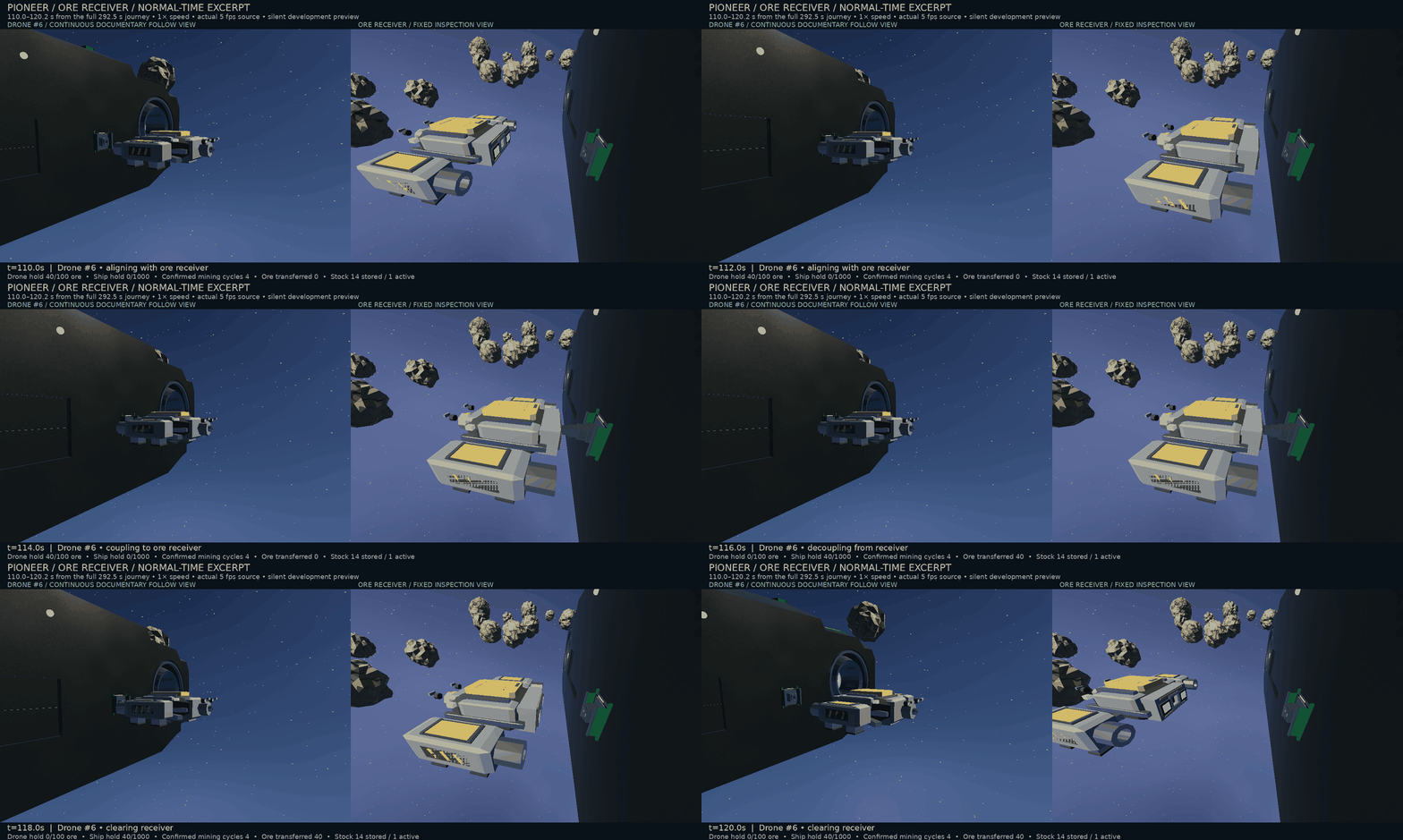
Watch the full 4:52.5 journey
Normal speed, no cuts or audio · MP4, 7.7 MB. Launch, mining, quick delivery, resumed mining and final recovery are kept in order.
One bay, actual departures and returns
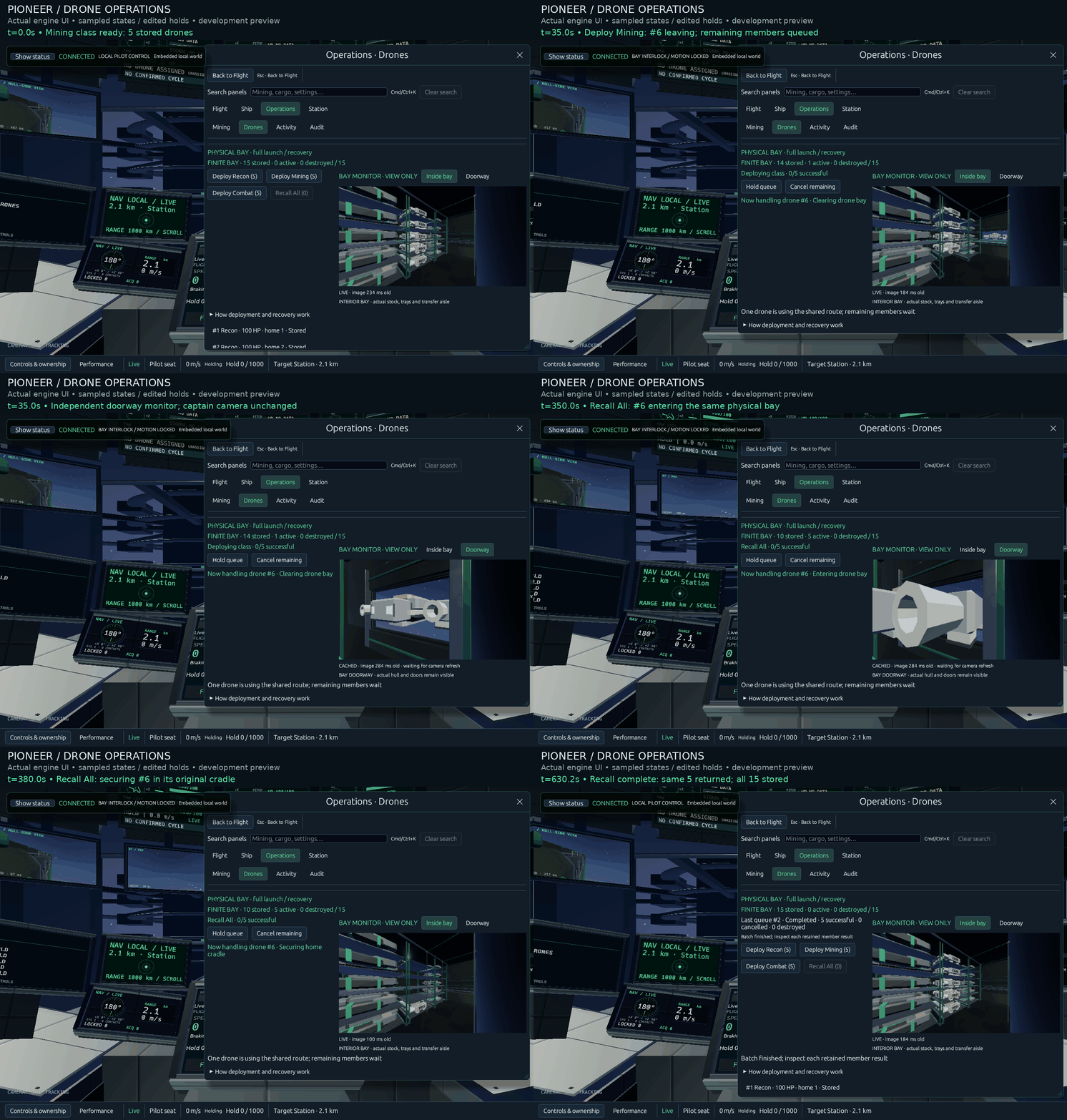
The drone controls now connect to a physical journey rather than an instant change to an inventory count. Deploying the mining class sends the selected drones through Pioneer’s shared bay. Recall All brings active drones back through that same recovery route. Stored, active and destroyed counts remain distinct, so an instruction to return is not treated as proof that the drone is already aboard.
An earlier five-drone run followed the same identities, 6 through 10, through five launches and five recoveries. It finished with all 15 drones stored and none active. The sampled controls reel below shows selected UI states from that 10-minute-30.2-second run. It is useful for reading the controls, but it is not continuous footage of the entire operation.
Delivering ore without ending the job
Quick delivery and final recovery serve different purposes. A mining drone can approach the ore receiver, transfer its cargo and return to work without becoming stored inventory. Recall All ends that work and brings the drone home. Keeping those paths separate makes the ship’s receiver more useful than a parking counter.
In the full recorded journey, mining drone 6 extracts 40 units of ore, delivers them in transfers of 25 and 15, then returns to mining for another 10. Recall All delivers those last 10 units before the drone stows. That is five confirmed extraction events, not six: a reserved cycle did not extract ore. The recorded ledger conserves the ore throughout, and credits do not change.
The current rules give a mining drone 100 units of cargo capacity, with extraction at 10 units per eight seconds and receiver transfer at up to 25 units per 500 milliseconds. Those are prototype rules, not a promise of final balance. The important connection is that extraction, carried cargo and delivered cargo agree.
Showing what is available, not just what is coming
The controls distinguish cargo already in the ship from incoming reservations. In the captured transfer panel, 40 units are reserved against a 1,000-unit hold, leaving 960 available to other incoming cargo. A reservation is not a completed delivery. Transfer progress and the stored/active drone counts make that difference visible instead of hiding it behind one changing number.
Camera freshness also remains part of the interface. The captured panel labels the age of its cached image, rather than implying that every displayed frame is current. The UI still below retains those labels and the actual prototype layout. It is not a redesigned mockup.
What was captured, and what was tested
The ore journey uses renderer c6f03b0 and authority 11325b7. It keeps 4 minutes 52.5 seconds in order at normal speed, with no cuts, acceleration or invented motion. The source views were captured every 200 milliseconds from a 100-millisecond authoritative sequence; the MP4 holds those frames in a 30-fps encoding. That encoding is not a claim of 30-fps source capture or live rendering performance.
Later source checkpoint e9ef19e recorded 1,471 passing tests, no failures and 76 ignored tests. The ignored checks are not counted as having run. This later qualification is separate from the footage’s revisions. Neither the test result nor the published film means this engine checkpoint has been released or installed on a player’s machine.
Pioneer remains a functional prototype with unfinished materials and natural camera occlusion. Its ships are official team-authored designs; players cannot currently customize their construction. Internal modular design helps us build and maintain the ship, but it is not a player ship-building feature.
The next work to close
The next acceptance work is about keeping this chain reliable when conditions are less tidy, not just making a shorter demonstration. These are open checks and development goals, not completed features:
- Exercise competing deliveries, full holds, interruptions and recovery queues without losing ore or double-counting a reservation.
- Keep physical bay state, drone identity, cargo and the controls consistent across save/restore and reconnect.
- Check camera freshness, text legibility and control reach on representative hardware; edited media cannot establish performance.
- Refine the ship’s materials and presentation while preserving the tested access routes and working mechanisms.
Inside the checkpoint
Deploy and Recall All, through the same bay
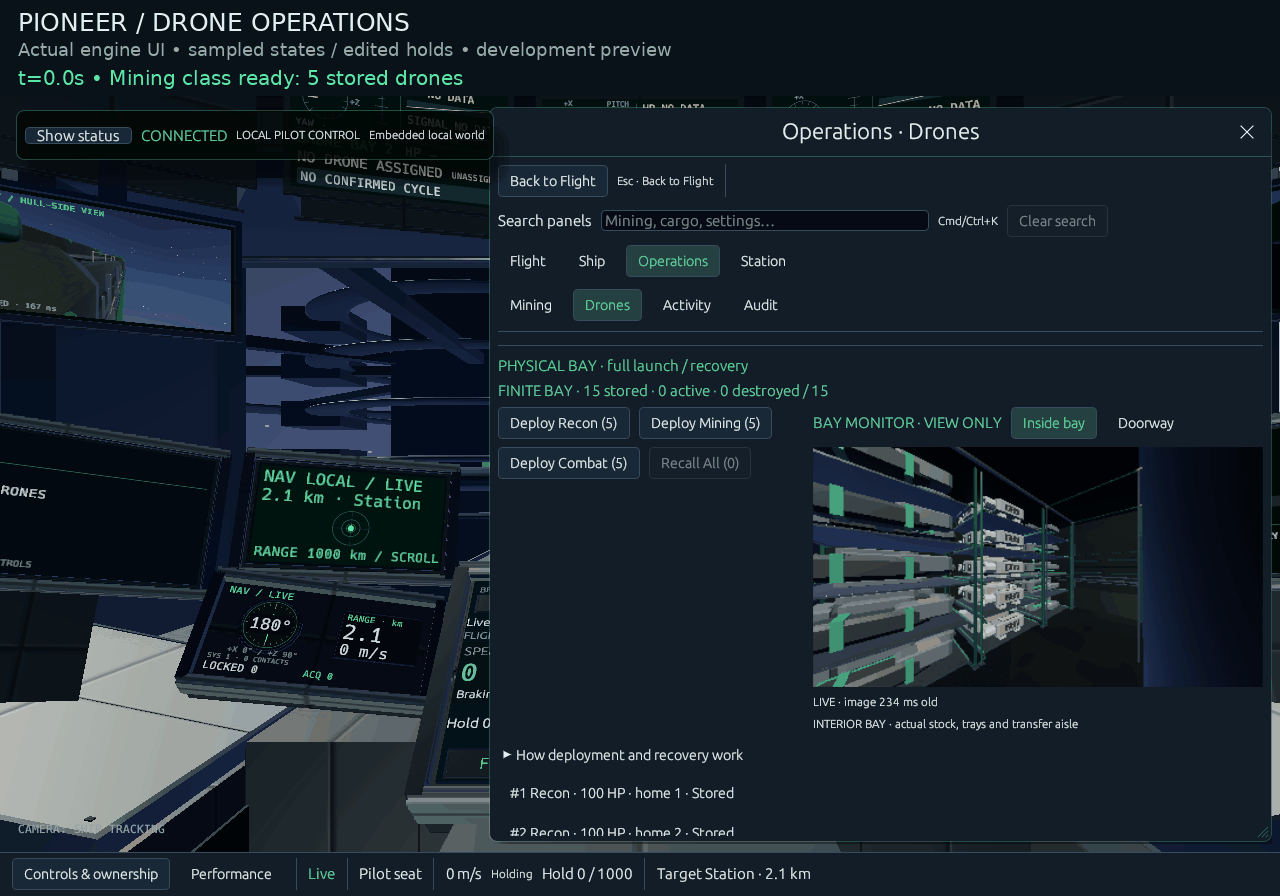
Play GIF Pause GIF · show still Capture details · motion paused Five-drone controls · sampled states
Seven selected UI states with edited holds, not a continuous 10:30.2 replay. Capture revisions: renderer d9fd266 and authority 4f1eb58. Edited playback is not a frame-rate benchmark. Reduced-motion settings or “Pause animations” show a still. Open original GIF. Open still.
A closer look at the controls