
Making room for a working cockpit
A centered bridge and seven physical camera monitors turn the cockpit into a place with moving equipment.
Published development checkpoints 49c17e9 and f2f3bb7; neither is presented here as a merged release or deployed feature.
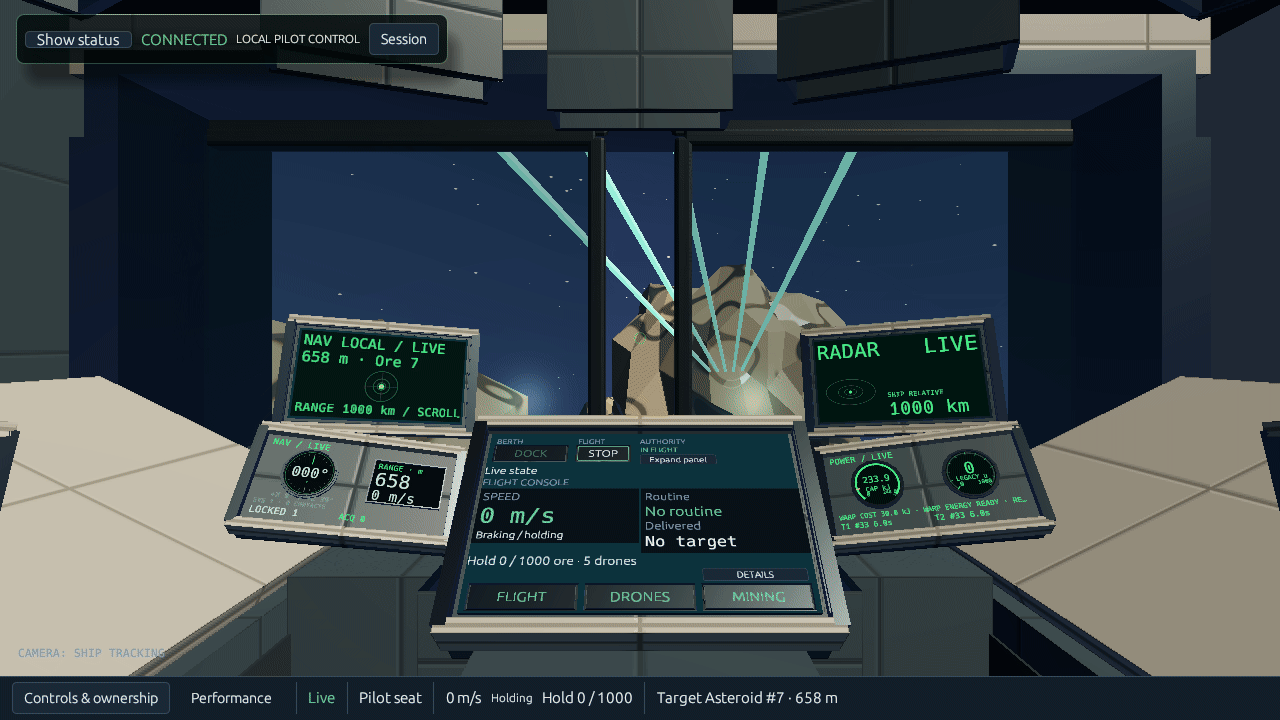
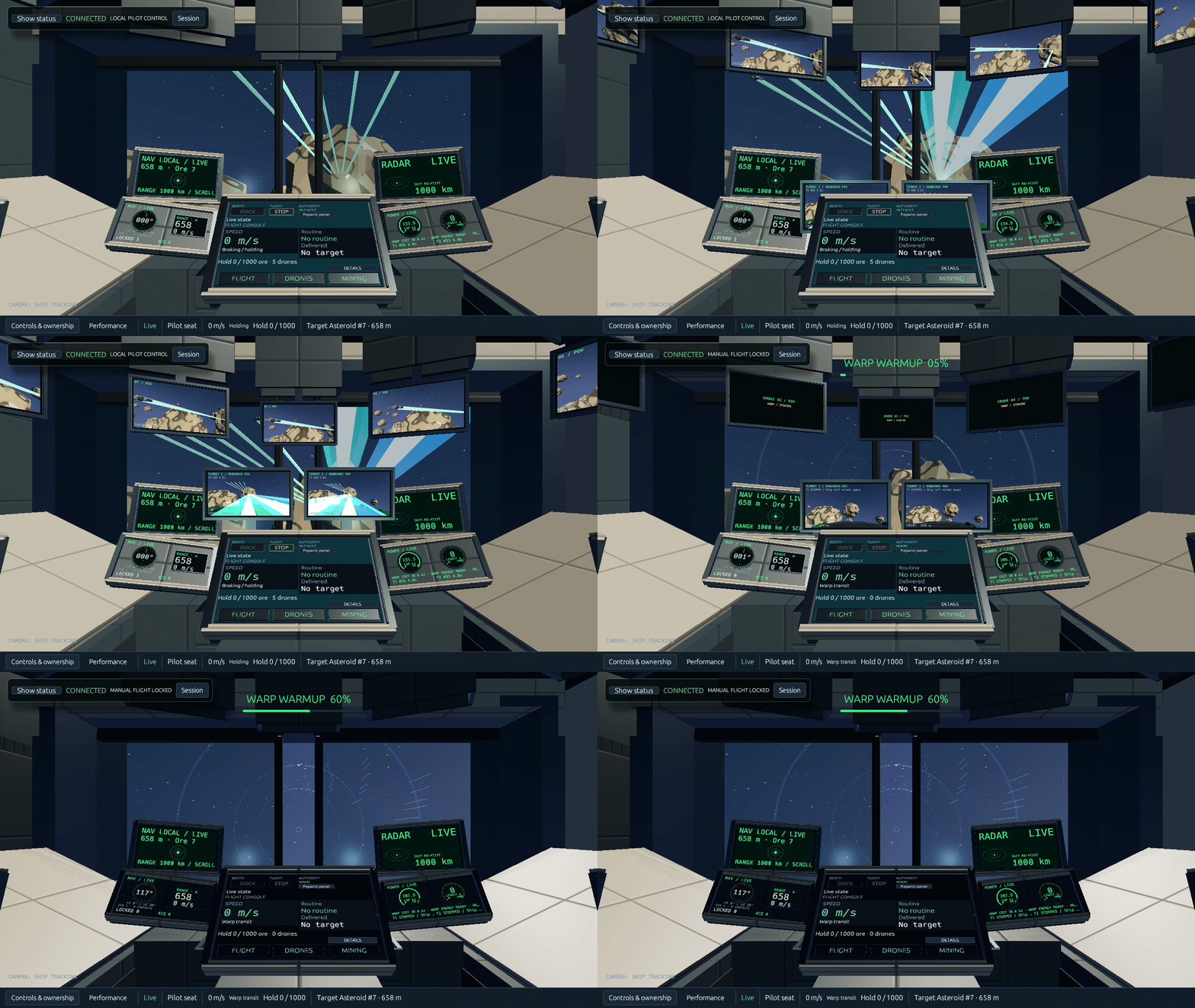
Play GIF Pause GIF · show still Capture details · motion paused Historical seven-screen sequence
Actual captured frames with edited playback timing and endpoint holds. Edited playback is not a frame-rate benchmark. Reduced-motion settings or “Pause animations” show a still. Open original GIF. Open still.
Make the space work first
The spatial redesign moved Pioneer toward a deeper, centered cockpit, with wraparound console construction, rear access and a framed canopy. Two-deck room-program blockouts extend that work beyond the seat. This is still a coarse foundation, but it establishes where the captain, instruments and circulation paths belong before finer detail is added.
The mining views then became physical equipment in that space. Five drone monitors lower from ceiling cassettes, while two turret monitors rise from the center console. Their supports, housings and stowed covers are geometry. Each drone has an assigned view, and the turret screens show their actual rendered perspective. The outer displays require head turns rather than being packed into a single front row.
Let the ship decide what moves
Confirmed vessel and activity state drives deployment and accepted-warp stow. Rendering, collision and input share the sampled mechanism poses, so a screen's visible position and its physical position follow the same state. Obstruction and persistence are part of that work: a blocked mechanism should report the blockage rather than pass through someone or silently jump to its destination.
The camera tests also made a useful distinction. A real feed can still be a poor view if the ship's own structure blocks it. An obstructed target exposed that problem; a legitimate forward-target journey demonstrated clear turret views without hiding the hull or moving the camera to an invented vantage point. Counting textures alone was not enough to establish a useful cockpit.
Keep the unfinished work visible
At this checkpoint, accepted warp starts stowing the monitors but does not wait for them to finish closing. Safe drone recovery and closure interlocks remain open. Seven displayed camera images also do not establish seven full-rate video streams; capture freshness and performance still need careful measurement.
The exact-head CI run failed, and the recorded client suite retained 11 inherited failures despite 489 passing tests. Those gaps stay attached to this development record. The historical animation is made from actual captured frames with edited presentation timing. It predates the closer-console refinement and helps show the path from a spatial blockout to moving hardware, without turning that progress into a release announcement.