
A steadier single bay
Pioneer’s local bay controls are easier to follow, a long startup stall is shorter, and the development work is being brought together without losing the earlier progress.
Development checkpoint, not a release. At 05:25 UTC on 27 October, consolidated checkpoint 68be74d was locally validated and unpublished. The earlier capture below is context, not footage of this checkpoint.
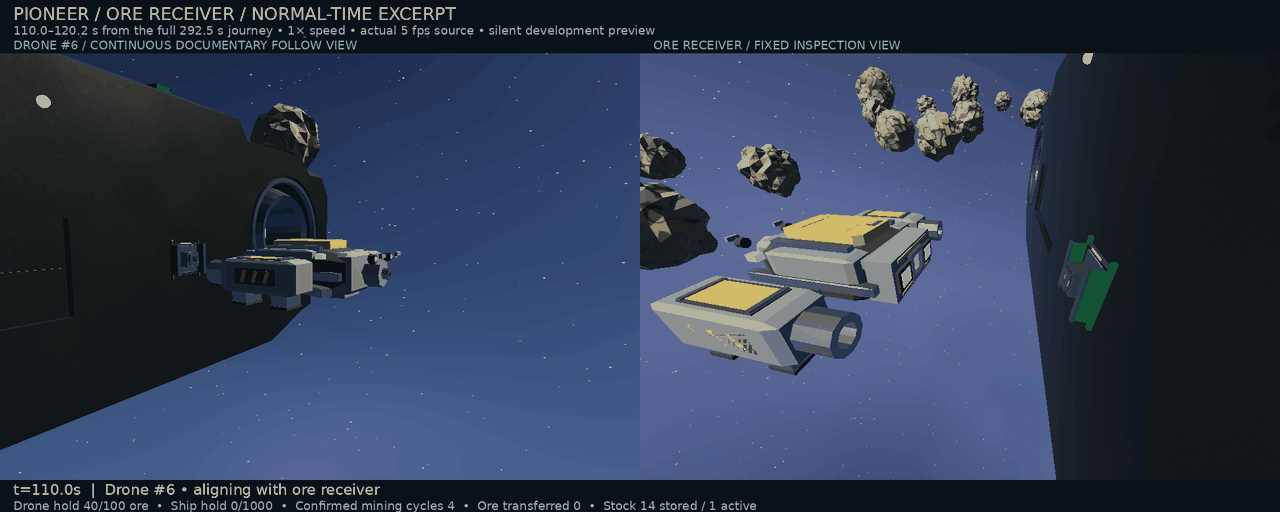
Play GIF Pause GIF · show still Capture details · motion paused Earlier capture · 25 October ore receiver
Earlier footage: 10.2 seconds at normal speed from the recorded ore journey, using renderer c6f03b0 and authority 11325b7. It does not show the new controls or measure their responsiveness. Edited playback is not a frame-rate benchmark. Reduced-motion settings or “Pause animations” show a still. Open original GIF. Open still.
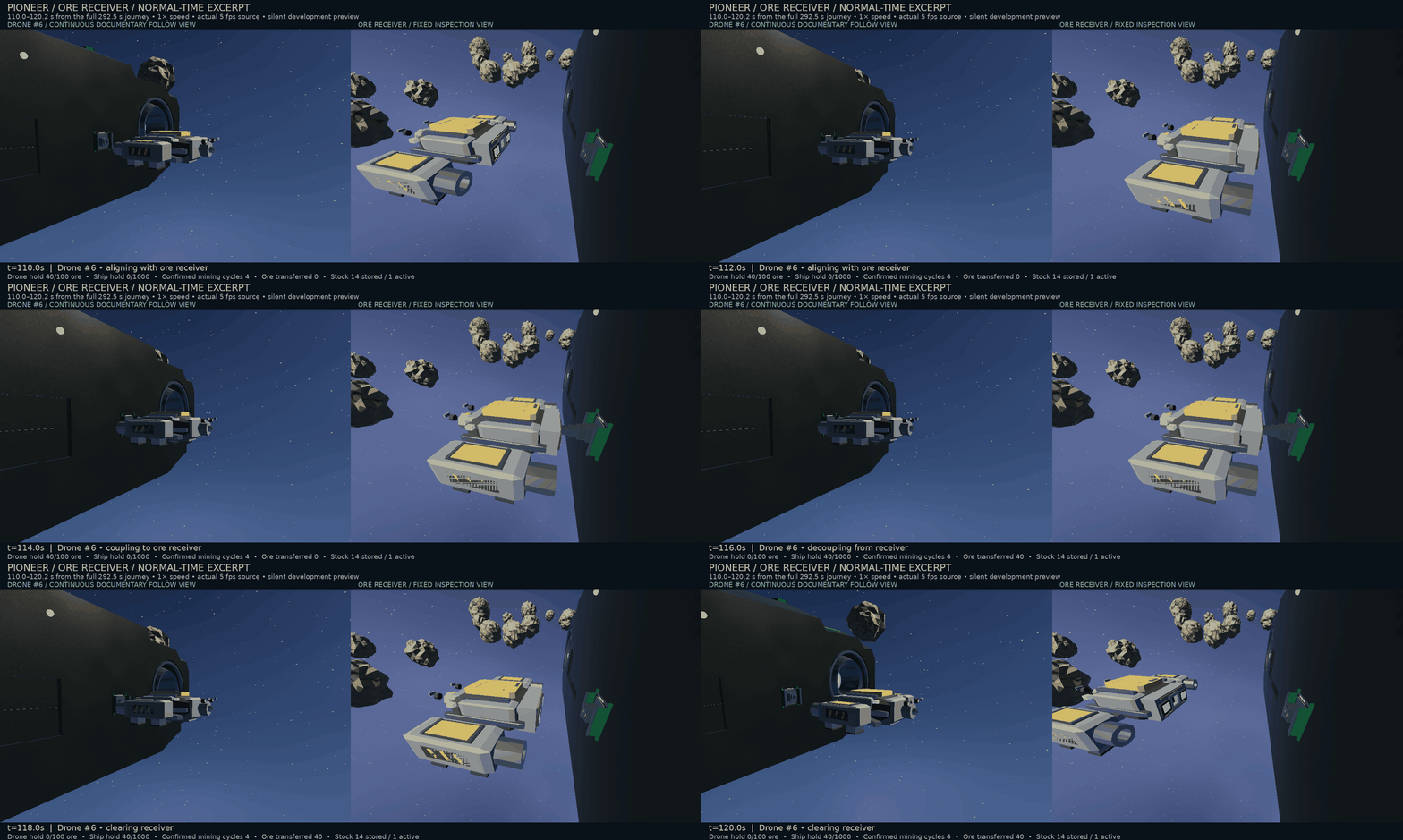
Following a command through the bay
The latest local, instrumented engine runs exercised Launch, Hide, Show, Hold and Recall in the single-bay preview. Launch, Hold and Recall received confirmed responses from the authority. Hide and Show changed the local view without issuing another ship command. That separation matters when checking whether the machinery accepted an instruction or the interface simply changed what it displays.
This remains a controlled single-bay test. It does not establish the full drone complement, a complete flight, or acceptance in a normal desktop window. Cargo and docking continuity checks also pass in the local test coverage; those checks remain separate from a complete playable flagship journey.
Removing the long first poll
The interface was spending too long processing startup observations. Bounding that presentation backlog and reusing verified immutable source data reduced the measured first UI poll from about 32.5 seconds to 0.9 seconds. Routine polling stayed below 4 milliseconds at the 95th percentile in the confirmation run. Command acknowledgements and authoritative state changes keep their ordered path; the change avoids accumulating old presentation updates.
These are polling measurements, not FPS. The 960 by 640 software-renderer run still took roughly 76 milliseconds per frame, and later profiling remained in the same range. There is no meaningful frame-rate gain to announce. Rendering cost, cold initialization and performance on representative hardware still need work before we can call the full cockpit responsive.
Keeping the progress together
The audited development work has been brought together locally with its history preserved. Public links now point to stable checkpoints, so the older journal and ship references can keep working through later cleanup. At this checkpoint, the old development branches remained in place; publication and verification on public main were still ahead.
There are smaller usability fixes in this pass too: search and Close remain reachable in the tested small-window layouts, and editor labels have been corrected. Keeping those controls usable is part of making the ship practical to inspect while its rooms and systems are still being finished.
What comes next
The next step is to extend the working pieces into the full ship while keeping the evidence specific. Pioneer remains an official team-authored ship, with unfinished rooms, integration and presentation. The open work is:
- Extend the physical single-bay proof to all 20 stored and deployable drones.
- Validate meaningful performance and input responsiveness on representative hardware.
- Complete the connected flagship loop and rooms, including the transitions between their working systems.